⚙️ LIMA SIX Armorers Course
Advanced — Gunsmiths & Armorers
Module 1: System Overview
The LIMA SIX is a belt-fed upper receiver system designed to mount on a standard AR-15 lower receiver. Unlike traditional box-magazine AR uppers, the LIMA SIX feeds from a disintegrating-link belt, introducing unique mechanical considerations that armorers must understand thoroughly.
Key Differences from Standard AR Uppers
- Belt feeding via a feed tray and feed pawl mechanism replaces the standard magazine well interface
- The carrier and bolt are purpose-built for belt-fed operation
- Timing and gas system tuning are more critical than in standard AR platforms
- A mandatory break-in procedure is required before full-auto or FRT operation
- Lubrication requirements are more aggressive than standard AR platforms — grease is preferred over oil
Build Kit vs. Complete Upper
The LIMA SIX is sold as either a build kit (requiring armorer assembly and gas port verification) or a complete upper (pre-assembled and validated). Build kit armorers must verify gas port sizing, gas block alignment, and buffer compatibility before declaring the system ready. Complete uppers skip the gas system checks and proceed directly to buffer configuration.
Supported Lower Receivers
- Mil-Spec AR-15 or M16
- Hydra Weaponry HYDRA 6
- Inoculum Group IGM7
Module 2: Gas System
Gas Port Sizing
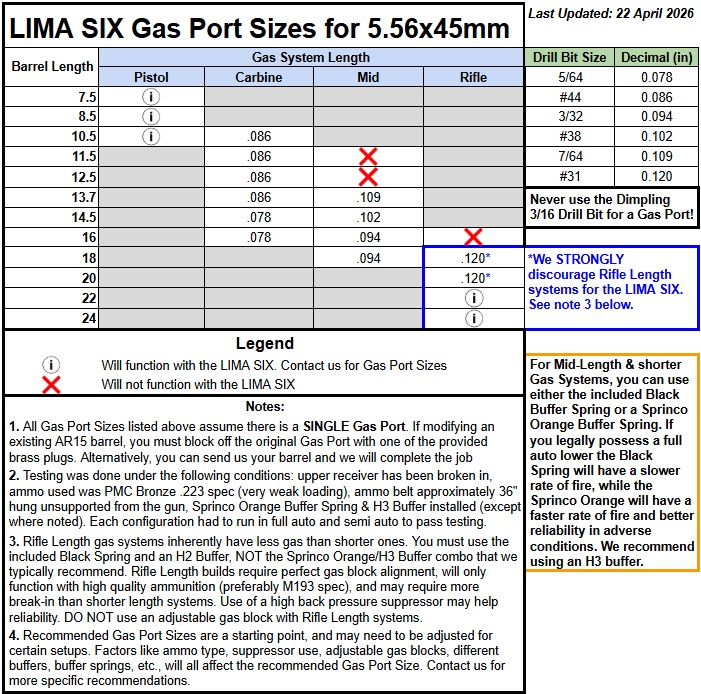
Gas port size is the most critical variable in build kit assembly. The correct diameter depends on gas system length and barrel length. Undersized ports cause under-gassing and cycling failures. Oversized ports cause over-gassing and accelerated wear — if a port is oversized, an adjustable gas block must be used to regulate flow.
Gas Block Types
Fixed Gas Block
The preferred choice for rifle-length gas systems and the simplest overall. Gas port sizing must be correct since there is no adjustment capability. Ensure proper alignment to the gas port.
Riflespeed Adjustable Gas Block
- For initial setup and break-in, start with the shortest plunger: .887″. The factory-installed plunger is .917″ and is generally too long for this configuration.
- Once broken in, sizing up to .897″ or .907″ may be necessary to prevent overgassing, particularly when running suppressed. Note: LIMA SIX factory complete uppers intentionally use .897″ because the gas port is oversized by .005″.
- Set to position 12 (maximum gas) to start. Reduce only once the gun is cycling consistently.
- Verify the plunger moves freely. If stuck: disassemble, clean, and lubricate.
- Riflespeed blocks inherently leak slightly due to moving parts — may require increasing gas port by ~.005″.
Superlative Arms Adjustable Gas Block
- Set to maximum gas to start: fully open = 18 clicks CCW from fully closed.
- Reduce gas setting only once the gun is cycling consistently.
Other Adjustable Gas Blocks
Set to maximum gas setting to start. Reduce only once the gun is cycling consistently. Ensure proper alignment to the gas port.
Hardware Requirements
- H2 buffer weight — H3 is not supported on rifle-length builds
- Black spring (KAK 308 Carbine) — Sprinco Orange is not compatible
- A5 or Rifle-length tube only — a Carbine tube creates too much spring preload even with the Black spring
Operational Notes
- Requires perfect gas block alignment
- High-quality ammunition required — M193 spec preferred
- May require additional break-in beyond the standard 200 rounds
- A high back-pressure suppressor may improve reliability
Gas Tube Installation
Two common installation errors cause complete gas failure:
- Upside-down installation: The gas hole in the tube must be oriented toward the barrel, not away from it.
- Wrong tube length: The gas tube must protrude approximately one inch into the receiver. An incorrect length results in zero gas reaching the carrier.
Module 3: Buffer, Spring & Spacer System
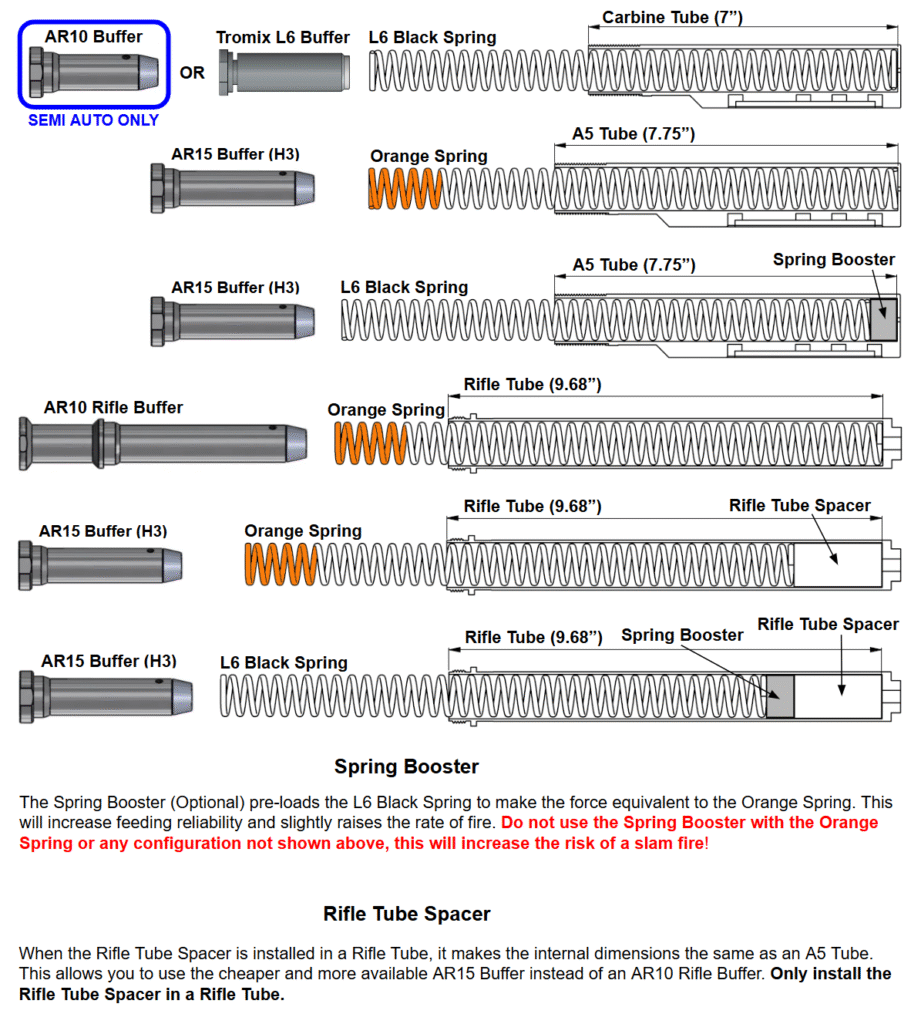
The LIMA SIX buffer system is more complex than a standard AR platform. The recoil spring type, buffer tube length, buffer selection, buffer weight, and optional spacers all interact. The spring preload is affected by tube length — a Black spring in a Carbine tube has significantly higher preload than the same spring in a Rifle-length tube. For this reason, the correct combination must be selected as a system, not as individual components.
Key Components
- L6 Spring Booster: Increases the preload of the Black spring to approximate the tension of the Sprinco Orange spring.
- L6 Rifle Tube Spacer (~2″): Shortens a Rifle-length tube to approximate the effective length of an A5 tube, reducing spring preload.
- Kurt Spacer: A single-piece combination of the Rifle Tube Spacer and Spring Booster.
Supported Buffer Configurations
Rifle-Length Gas System Buffer Requirements
For rifle-length gas systems, a weaker spring preload is required due to the lower gas pressure. The two recommended configurations are:
- AR15 Buffer (3.25″) / H2 / Black Spring / No Spacer / A5 (7.75″) tube
- AR15 Buffer (3.25″) / H2 / Black Spring / L6 Rifle Tube Spacer / Rifle (9.68″) tube
Note: The Black spring must be installed in an A5 or Rifle-length tube for rifle-length gas systems — a Carbine tube creates too much preload even with the Black spring.
FRT / Super Safety Spring Requirements
FRT and Super Safety triggers generally benefit from a stiffer spring preload. This is achieved through either the Sprinco Orange spring or the Black spring with a Spring Booster. The correct combination depends on the tube length — consult the supported configurations table above. When running an FRT on a rifle-length gas system, use the weak spring configuration (rows 10–11 above) and ensure the system is fully broken in, well lubricated, using quality ammunition, and avoid long unsupported belts.
Module 4: Lower Receiver & Trigger Systems
Semi Auto
Standard mil-spec semi-auto triggers are supported without restriction. Buffer weight verification and timing video review are not required for semi-auto configurations.
Full Auto
Requires completion of the 200-round break-in in semi-auto mode before full-auto operation.
FRT / Super Safety Triggers
- Light trigger pull is mandatory. Excess force creates drag on the bolt carrier — a primary cause of FRT malfunctions.
- 200-round break-in in semi-auto must be completed before FRT operation
- Spring selection must match tube length (see Module 3)
FRT / Super Safety Device Types
| Device | Special Notes |
|---|---|
| Hoffman Style Super Safety | — |
| Hoffman Trigger Kicker | — |
| AS Designs ARC Fire | Must use trigger provided with the unit — no substitutes or DIY modifications |
| Atrius Forced Reset Selector | May be incompatible with some older Hydra HYDRA 6 lowers — direct to Hydra if issues arise |
| Arizona Regulator | — |
| Triggered Disruptor (Formerly Partisan) | Increased carrier drag even in semi-auto mode — avoid during break-in |
| Rare Breed | Increased carrier drag even in semi-auto mode — avoid during break-in |
| Delta Team Tactical | Increased carrier drag even in semi-auto mode — avoid during break-in |
Module 5: Break-In Procedure
The 200-round break-in is mandatory before any Full Auto or FRT / Super Safety operation. It is the leading cause of reliability issues when skipped or shortcut.
Break-In Procedure
- Install a lightweight buffer. Do NOT use a heavy buffer (H1–H3) during break-in.
- Semi-auto only with a mil-spec trigger. Cassette-style FRT triggers must not be used during break-in even in semi-auto mode — they create additional carrier drag that interferes with the process.
- Lubricate liberally with grease as specified in the operators manual.
- If using an adjustable gas block, set to maximum gas setting.
- Use short belts or hand-support the belt to prevent belt weight from interfering with cycling.
- Fire 200 rounds total in semi-auto mode.
Post Break-In Setup
- Install the correct operational buffer and spring combination for the configuration (see Module 3)
- Watch the LIMA SIX Timing Video before declaring the unit ready for full-auto / FRT operation
- Reinstall o-ring if removed during break-in
Last-Round Flyer
When evaluating accuracy, exclude the last round from each belt. The delinking process can slightly deform the last round, causing a displaced impact. This is a normal characteristic of all belt-fed systems and is not a LIMA SIX defect.
Accuracy Troubleshooting
- Try a different brand or type of ammunition
- Inspect and clean the rifling — carbon buildup can degrade accuracy
- Always exclude the last round when evaluating groups
Module 6: Armorer Troubleshooting Guide
Failure to Fully Chamber — Loading First Round
- Check lubrication (refer to operators manual lubrication video)
- Remove o-ring from extractor spring during break-in to test for improved bolt closure — reinstall afterwards
- Verify both ejectors can be depressed flush to the bolt face
- Inspect extractor for burrs; polish if present
- Deburr the front left edge of the feed tray with fine-grit sandpaper or emery cloth
Failure to Fully Chamber During Firing / Undergassed
- Verify adjustable gas block is at maximum setting
- If Riflespeed: confirm plunger moves freely; if stuck, disassemble, clean, lubricate. Confirm .887″ plunger installed and set to position 12
- Test with different ammunition (5.56×45 M193 spec recommended)
- Check lubrication
- Remove o-ring from extractor spring during break-in — reinstall afterwards
- Verify ejectors can be depressed flush to bolt face
- Inspect extractor for burrs; polish if present
- Check gas key for looseness — wiggle firmly; it must not move at all
- Deburr front left edge of feed tray
Failure to Fire — Semi Auto
- Inspect hammer spring for upside-down installation
- Test with different ammunition
Failure to Fire — Full Auto / FRT / Super Safety
- Suspected bolt bounce or timing issue
- Direct operator to watch LIMA SIX Timing Video
Zero Gas (Carrier Does Not Move)
- Inspect gas key on bolt carrier — remove any stuck primer
- Verify gas tube is not installed upside-down (gas hole must face the barrel)
- Verify gas tube length — must protrude approximately 1 inch into receiver
Accuracy Issues
- Exclude last round from group evaluation (last-round flyer phenomenon)
- Try different ammunition
- Inspect and clean rifling in barrel
Hours: Monday–Thursday, 8am–6pm Eastern
Module 7: Armorer Certification Test
25 questions — multiple choice. A score of 80% or higher (20/25) is required to pass.